COSTA RICA
'Pura Vida':
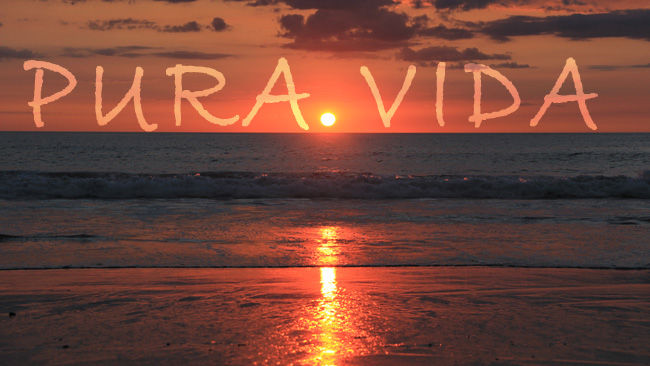
Costa Rica's unofficial motto. Simply translated, it means 'simple life' but in Costa Rica it is a way of life. Costa Ricans (Ticos) use this term to say hallo, to say goodbye, to say everything's great. Pura Vida is the way Ticos live: to them it means to be thankful for what they have and not concentrate on the negative.

Why Costa Rica?? We'd been talking about going to South America for years but could never fix on exactly which country or where. So we decided to visit Central America instead/first. We'd heard good things of Costa Rica and started to look for a tour that didn't just involve the beach and that wasn't too exclusively themed, eg Food or Birds or Adventure.
Saga looked to tick the right boxes as it seemed to offer a variety of interesting activities and sights BUT it proved to be a disappointing choice. There was far too much repetition in the excursions and no real opportunity to meet or even speak to Costa Ricans other than those serving us.
Costa Rica's unofficial motto. Simply translated, it means 'simple life' but in Costa Rica it is a way of life. Costa Ricans (Ticos) use this term to say hallo, to say goodbye, to say everything's great. Pura Vida is the way Ticos live: to them it means to be thankful for what they have and not concentrate on the negative.
Why Costa Rica?? We'd been talking about going to South America for years but could never fix on exactly which country or where. So we decided to visit Central America instead/first. We'd heard good things of Costa Rica and started to look for a tour that didn't just involve the beach and that wasn't too exclusively themed, eg Food or Birds or Adventure.
Saga looked to tick the right boxes as it seemed to offer a variety of interesting activities and sights BUT it proved to be a disappointing choice. There was far too much repetition in the excursions and no real opportunity to meet or even speak to Costa Ricans other than those serving us.
HISTORY
Costa Rica was first inhabited around 10,000 BC, about 25,000 years after the first Homo Sapiens crossed the Bering Strait into what is now the Americas. It was a contact zone, a corridor for merchants and trading expeditions. When the Spaniards arrived in the 16th century it was inhabited by as many as 27 different clans who existed in a state of almost constant warfare.
On 18 September 1502, on his fourth and last voyage to the Americas, Christopher Columbus sighted Costa Rica, coming ashore near Puerto Limon. The group stayed 17 days and came to the mistaken conclusion of potential riches to be had. In fact the gold worn by the welcoming indigenous envoys was the result of trading or warfare.
In 1506 King Ferdinand of Spain sent an unsuccessful expedition beset by shipwreck, impenetrable forests and violent resistance from the natives. A second expedition in 1521 concentrated on the Pacific coastline, baptising 32,000 as they went but were again met with ferocious resistance that was not overcome until 1540 when Costa Rica was declared a Royal Province of Spain.
The real conquerors turned out to be smallpox, influenza and measles. An indigenous population estimated at 80,000 in 1563 by 1714 was recorded as 999.
Central America's declaration of independence from Spain in 1821 made very little difference at first for Costa Rica other than the establishment of San Jose as capital in 1823. Later in the century, however, remarkable progress was made in the building of roads, railways and bridges paid for by the coffee trade.
The 20th century saw a difficult transition to democracy. In 1940 Calderon was elected President and he instigated the social reforms and state support for which Costa Rica is still almost unique in the region. Opposition to him and his followers eventually culminated in the 'revolution' of 1948, a new constitution and the abolition of the army. Since then the country has in the 1980s suffered economic crisis and staggering debt; tensions with the USA and involvement in the Nicaraguan civil war; a massive earth quake (1991); waves of refugees from the rest of Central America seeking asylum (1992); membership of NAFTA (1995); escalating violent crime and drug trafficking.
SAN JOSE:
The tour kicked off with a morning tour of San Jose, and visits to the National Museum and the National Theatre. Apart from that, and the coach ride to and from the airport, this was all we were going to see of the capital city.
National Museum:
The museum is located in the Bellavista Fortress, originally a military barracks built in 1917 which became the museum site in 1950 after the 1948 civil war which abolished the army. The website shows it to be a striking building but such was the nature of our tour we must have parked round the back as we have no pictures of it and no recollection of the architecture!
If we had been visiting independently we would have spent a couple of hours exploring the exhibits but the limited time available was well-organised with a very knowledgeable guide who spoke excellent English. Unfortunately, but understandably, no photography is allowed of the fascinating displays inside on the country's history and culture from pre-Columbian times to the present . The only place we could take pictures was the courtyard.
 |
| Mysterious Giant Rock Ball |

Ceremony Table


National Theatre:
Next up was a whistle-stop visit to San Jose's magnificently ornate National Theatre, funded by a tax on coffee, then the principal export product, and constructed 1891-97.


OROZI VALLEY and IRAZU VOLCANO:
After spending our first night at the Barcelo San Jose, we set off the 34 miles to the Central Volcanic Range driving through the Orosi Valley. One of the country's first areas to be settled (archaeological excavations date back to 1000B.C.), it has been one of the last to be developed for tourism. With a humid climate and surrounded by hills and lush vegetation, it is a major area for producing coffee and sugar cane.


We travelled 50 kms. west of San Jose to the Irazu Volcano National Park, the volcano being named either from the combination or 'ara' (point) and 'tzu' (thunder) or a corruption of 'Iztaru' which was the name of an indigenous village on the flanks of the volcano. In Costa Rica it is known as 'El Coloso' (The Colossus) standing 11,260 feet tall and 500 square kms at its base. It is active, the first documented eruption being in 1723 and the most recent in 1994. The most famous eruption began a few days before President Kennedy started a state visit to Costa Rica in 1963 and continued for 2 years.
The area surrounding the volcano is flat and bare for the most part, coated in extremely fertile volcanic ash and with very few animals apart from coyotes, squirrels, armadillos, rabbits and foxes able to survive the harsh conditions.


There are several craters, two of particular interest. We walked up to the larger which is 900 feet deep.


The only other volcano we have visited is in Lanzarote and while Izaru lacked the spectacular moonscape of the Canaries we felt that it was in many ways more impressive with its lack of commercialisation and simplicity. What you saw was what you got.


It had been a pretty gloomy day weather-wise thus far but the sun came out for the last part of our journey to the hotel. Perfect timing for a brief stop at the only Pacific-coast beach we were to see in Costa Rica. A taste of what we were missing!


 Steve and Eugenia


Lunch!!
And then it was on to a local restaurant for a very welcome lunch. Can't remember what we had to eat as Costa Rican food up to now had been cosmopolitan. But although the meal was unremarkable the restaurant setting was beautiful .........


........ and there was plenty of time to wander around the attractive gardens.


It had been a pretty gloomy day weather-wise thus far but the sun came out for the last part of our journey to the hotel. Perfect timing for a brief stop at the only Pacific-coast beach we were to see in Costa Rica. A taste of what we were missing!


stunning photos x
ReplyDelete