24-28 October
'City of Joy'
'..if you want a city with a soul, come to Calcutta' (Vir Sanghvi)
The name Calcutta probably originated from kalitkutir, the house or temple of Kali. By the time of the establishment by Job Charnock of the headquarters of the East India Trading Company on the east bank of the Hooghly river in 1690, the riverside was already dotted with trading communities from many European countries. With trading success came plans for development. After becoming entangled in local politics the British became masters of Bengal and the Company's trading monopoly was recognised by Parliament in London in 1773. Calcutta became a clearing house for a vast range of commerce, including the lucrative export of opium to China. The East India Company brought out young bachelors from Britain to work as clerks. Many took Indian wives giving rise to the new Anglo-Indian community and, after the Company's monopoly was withdrawn, the cultural melting-pot was added to by Parsi, Baghdadi Jew and Afghan merchants.
The ensuing boom lasted for years. On the surface Calcutta's splendid buildings built at this time earned it the title 'City of Palaces' but the reality was one of an uncomfortable climate and unhygenic conditions leading for many to lives of misery and disease. The city's death as an international port came with the opening of the Suez Canal in 1869 which led to the emergence of Bombay and the end of Calcutta's opium trade.
Since Indian Independence the city's poverty has been high-lighted by the work of Mother Teresa. The 1952 population of 2.4 million was already posing huge problems for the city to deliver adequate services but it had swelled to an astronomical 14.3 million in 2011, as a result of its geographical position and political factors completely out of its control resulting in waves of mass migration of dispossessed refugees [following Partition (1947), the Hyderabad annexation by India (1948), Pakistan becoming an Islamic state (1956) and the Bangladesh Liberation War (1971)].
GETTING THERE:
Our 9 hour Jet Airways flight took us from Heathrow to Mumbai where we changed to an internal flight to Kolkata.
Some Observations:
- we'd upgraded to Premium Economy and so had a bed(!) to sleep in. Real luxury.
- BUT don't fly Jet Airways for its in-flight entertainment! It's dreadful.
- inevitably we were cuckooned from Indian reality till we taxied in Mumbai for the flight to Kolkata. You've read about the poverty and seen it on TV but nothing prepares you for the vast shanty town of shacks built practically on the runway. I suppose we had been expecting this in Kolkata, with its reputation for extreme poverty, but in reality Mumbai and Delhi's poverty is just as endemic. Nearly 3 weeks later we were to stay in Mumbai and see what a vibrant, modern, cosmopolitan and monied city it was becoming for many, but far from all, which only made the 'runway city' more tragic.
THE HISTORY
One of the 4 great urban centres of India, Kolkata was until 1911 the imperial capital of India, when it was replaced by Delhi.The name Calcutta probably originated from kalitkutir, the house or temple of Kali. By the time of the establishment by Job Charnock of the headquarters of the East India Trading Company on the east bank of the Hooghly river in 1690, the riverside was already dotted with trading communities from many European countries. With trading success came plans for development. After becoming entangled in local politics the British became masters of Bengal and the Company's trading monopoly was recognised by Parliament in London in 1773. Calcutta became a clearing house for a vast range of commerce, including the lucrative export of opium to China. The East India Company brought out young bachelors from Britain to work as clerks. Many took Indian wives giving rise to the new Anglo-Indian community and, after the Company's monopoly was withdrawn, the cultural melting-pot was added to by Parsi, Baghdadi Jew and Afghan merchants.
The ensuing boom lasted for years. On the surface Calcutta's splendid buildings built at this time earned it the title 'City of Palaces' but the reality was one of an uncomfortable climate and unhygenic conditions leading for many to lives of misery and disease. The city's death as an international port came with the opening of the Suez Canal in 1869 which led to the emergence of Bombay and the end of Calcutta's opium trade.
Since Indian Independence the city's poverty has been high-lighted by the work of Mother Teresa. The 1952 population of 2.4 million was already posing huge problems for the city to deliver adequate services but it had swelled to an astronomical 14.3 million in 2011, as a result of its geographical position and political factors completely out of its control resulting in waves of mass migration of dispossessed refugees [following Partition (1947), the Hyderabad annexation by India (1948), Pakistan becoming an Islamic state (1956) and the Bangladesh Liberation War (1971)].
We were to spend 2 full days in Kolkata and inevitably there was a lot to take in from the off, not least finding the others in our group. We'd been travelling with them for over 24 hours but as yet had had no idea who they were, or even how many of them there were, amongst the hundreds on the plane. In the event, 18 of us plus Rudy, our guide for the next 19 days, piled into the coach for the 90 minute ride to our hotel, the Lalit Great Eastern in the heart of Old Calcutta.

We wouldn't normally welcome another 90 minutes travelling but, as well as showing us how clogged Kolkata traffic was and how early dusk came, it was a fascinating and exhilarating introduction to India:

We wouldn't normally welcome another 90 minutes travelling but, as well as showing us how clogged Kolkata traffic was and how early dusk came, it was a fascinating and exhilarating introduction to India:
- the sounds of vehicle horns constantly blaring;
- the sight of a sea of put-puts and mopeds weaving their way between what seemed like hundreds of taxis and cars;
- the mass of people, almost all brief-case-carrying men, purposefully scurrying in all directions;
- children, in pristine uniform, going home from school;
- the colours: yellow taxis, green put-puts, saris in all shades, neon-lit shops displaying fruit and vegetables;
- the street food on sale everywhere, cooked in huge vats or pans on the pavement on kerosene burners
OLD CALCUTTA:
'As we enter the town, very expansive square opens before us, with a large expanse of water in the middle, for public use… the square itself is composed of magnificent houses which render Calcutta not only the handsomest town in Asia but one of the finest in the world. One side of the square consists of a range of buildings occupied by persons in civil employments under the Company, such as writers in public offices.'
(L. de Grandpre, A Voyage in the Indian Ocean and to Bengal (1803))The commercial and administrative hub of Kolkata is BBD Bagh which Kolkatans refer to as Dalhousie Square. (The name commemorates three revolutionaries hanged for trying to kill Lieutenant-Governor General Lord Dalhousie.) Our first morning was to be spent on a walking tour of what was once British Calcutta, seeing the architectural impact of colonialism.
 |
| A local guide who accompanied us. |
First stop was the Governor's House, until 1911 the residence of the British governor-generals and the viceroys of India but now the official home of the Governor of Bengal.

It is not open to the public, and on the day we visited vehicle access was also restricted due to the large crowds expected to celebrate Diwali.

The Town Hall has until recently been open to the public but is now unfortunately closed and due for demolition as part of a controversial modernisation project. Before closure it housed the Kolkata Panorama, a museum dedicated to the popular history of the city, and there has been speculation that its closure, and promised relocation, has more to do with corruption than the planning needs of the city.


.... not least in the Indian judicial system. The Calcutta High Court, established in 1862, is the oldest High Court in India. The building's design, for reasons that were never explained to us, is based on the Cloth Hall in the Belgian city of Ypres (!)


connecting the 19th century building in a poorly-executed attempt to blend in.

Significantly less impressive are the barristers' chambers.

 |
| Enough said! |

As ever in this country of vast disparity, we found that irony was never far away. As we walked past the High Court a huge mound of rotting rubbish was being shovelled-up and removed by a group of men accompanied by their families and an assortment of stray dogs. Heartbreakingly, a small child was tethered by a rope to a pole presumably, and hopefully, to prevent it playing in the rotting mound. We were too upset and embarrassed by our total inability to make anything better to take any pictures until we were past the group.

ST. JOHN'S CHURCH:
Another of the British churches dotted around this district, originally a cathedral, St John's Church is familiarly referred to in Kolkata as 'the stone church'. It is the third oldest church in the city and was among the first public buildings erected by the East India Company. Modelled on St Martin-in-the-Fields of London, it was completed in 1787.

The compound of the church houses a number of memorials.

 |
| The impressive organ pipes |
The compound of the church houses a number of memorials.
- Job Charnock's Mausoleum: Charnock is seen as the founder of the city of Calcutta. The octagonal Moorish-style tomb was erected by his son-in-law. Charnock earned eternal notoriety for marrying a Hindu girl he saved from the funeral pyre of her first husband

- During the height of the Indian independence movement in 1940 the British moved the Black Hole of Calcutta monument to the compound of St John's Church.


- Some, poignant and telling a more everyday story of colonial life.

VICTORIA MEMORIAL:
https://en.wikipedia.org/wiki/Victoria_Memorial,_Kolkata

With its formal gardens and water courses, the Victoria Memorial is Kolkata's pride and joy.
This hybrid building, with Italianate statues over its entrances, Mughal domes in its corners and elegant open colonnades along its sides, was conceived by Lord Curzon to commemorate the Empire at its peak. By the time it was completed in 1921 Victoria had been dead 20 years and the capital of the Raj had shifted to Delhi.

 |
The original steeple was destroyed in the 1897 earthquake. This too was destroyed by a second earthquake in 1934.

To improve ventilation, the lancet windows inside extend to plinth level and tall fans hang from the ceiling.Well-preserved plaques and memorials to long-perished imperialists adorn the inside. The most outstanding of these is the stained glass of the west window, designed by Sir Edward Burne-Jones in 1880 to honour Lord Mayo, assassinated in the Andaman Islands .

PARK STREET CEMETERY:
Rounding off our tour of 19th century Christian sites, we visited what was one of the earliest non-church cemeteries in the world. Opened in 1790, the cemetery was in use till 1830 and is now a heritage site. It holds 1800 tombs, built in Gothic and Indo-Saracenic styles, and served as the burial-ground for the British ex-pats who were settled in Calcutta in colonial times.The high walls that were built around the cemetery were to contain the danger of dead bodies spreading contagious diseases. Interestingly, burials only used to take place after dark.
Visiting cemeteries can be interesting but in truth there was little of interest beyond a few tombs as little of the epitaphs were deciferable.

MOTHER HOUSE:
It's impossible to be a tourist in Kolkata without visiting the Mother House,


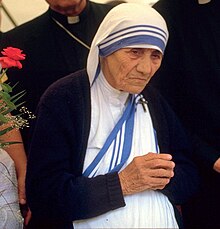
Born in Skopje to Albanian parents, she joined the Irish Order of Loreto and was sent to teach at St Mary's School in Darjeeling where she became aware of the terrible poverty around her.
( By an extraordinary coincidence, Anne, one of our tour party, had been a pupil at St Mary's 1946-53 and had decided to join our tour so that she could privately visit the school and show her husband, Stewart, the places of her youth that she had spoken to him about so much. She remembered Mother Teresa as a quiet and unremarkable nun.)
In 1948, with Papal approval, Mother Teresa left Darjeeling for Kolkata and established the Missionaries of Charity and their many homes, clinics and hospices for the poor and destitute.
 |
| Nuns wearing their habits of simple blue-bordered saris. |
Whatever the veracity of these criticisms, we were both struck by the aura of the Cult of Personality in the photo display in the Mother House which underscores the difficulty in making constructive criticism of an undoubtedly remarkable woman.
In a lighter vein, next door to the Mother House an enterprising hotelier has seen an opportunity for an appropriate name ....

... while at the back of the Mother House is the Communist Party HQ (!) with an interesting example of a capitalist sideline.


Really interesting to see lots of different aspects of the city. It must have been a tiring day to fit all that in. The poverty sounds horrific and heart breaking though.
ReplyDelete